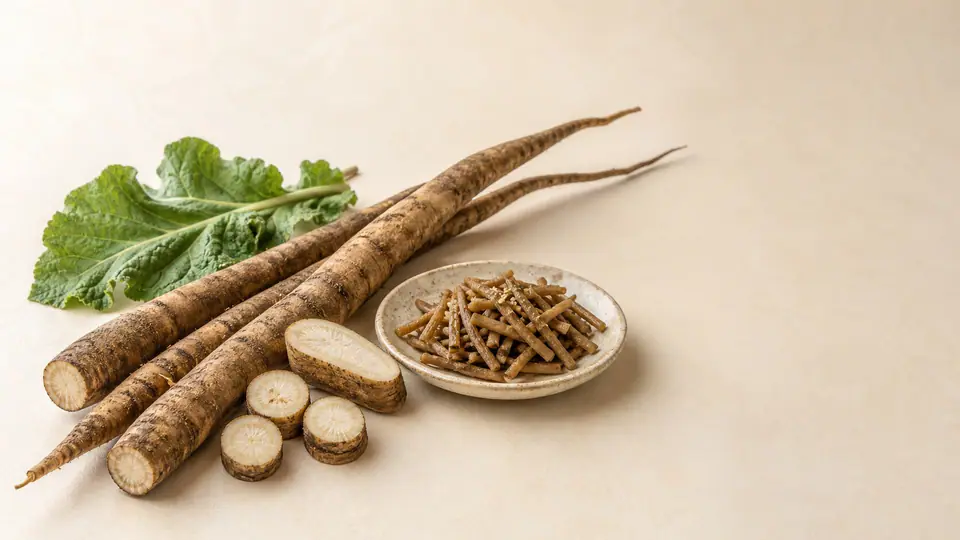
Between the Underground Root and the Seeds That Cling to Clothes
Is it okay to drink burdock tea like water or take burdock powder for blood sugar or inflammation? Burdock is a root vegetable familiar to us as both a side dish and a tea. However, familiarity does not equate to treatment. If you view burdock as a tool for detoxification or blood sugar management, you must first distinguish which part of the plant you are consuming, in what form, and in what quantity.
Burdock is a plant from the Asteraceae family Arctium lappawhose long, fleshy roots are eaten as a vegetable. Kew classifies this plant as an Asteraceae native to temperate Eurasia. What is commonly seen on Korean tables is the root. However, Ubangja, used in traditional medicine, refers to the mature seeds. If these parts are not distinguished, research on root tea may be misapplied to seeds, and the pharmacological results of seeds may be misapplied to side dishes.
The Identity of Burdock: Between Root Vegetable and Medicinal Seed
To define burdock in one sentence, it is a plant from the Asteraceae family Arctium lappawhose long, fleshy roots are eaten as a vegetable. Edible roots, burdock tea, root powder, concentrated extracts, and the mature seeds used as a Korean herbal medicine (Ubangja) all fall under the same name, but the plant part, components, and dosages differ. Under the name 'burdock,' roots and seeds, side dishes and teas, and powders and extracts are all mixed together.
How Burdock Became Known as a Detox, Blood Sugar, and Anti-Cancer Food
Burdock root can be a vegetable and a source of fiber. However, this does not automatically mean it provides detoxification, blood sugar control, or anti-cancer treatment. Antioxidant and anti-inflammatory effects seen in test tubes are different results from the relief of joint pain, improvement of blood sugar, or changes in disease progression in humans. A change in a few markers in a small trial does not mean symptoms or diseases have been cured. In other words, the broad label of 'detox root' masks the differences between root tea, powder, and concentrated extracts.
Root Side Dishes, Teas, Powders, and Extracts Are Not the Same Burdock
Edible roots, burdock tea, root powder, concentrated extracts, and the Korean herbal medicine Ubangja are all different formulations. The inulin, fructans, and fiber in burdock roots are not the same as isolated components or concentrated extracts. Since braised dishes are eaten with sugar and soy sauce, one must distinguish the fiber of the burdock from the total amount of sugar and sodium. Tea is infused in water, powder is ground root, and extracts are concentrated specific components. Every time the form changes, the effect on the body changes.
What Human Trials Actually Demonstrate
In a trial observing 36 patients with knee osteoarthritis for 42 days, three cups of burdock root tea per day altered some inflammation and oxidative stress markers. However, all participants used their existing medications concurrently, and this was not a large-scale trial confirming improvement in pain or function. In a 12-week study of 60 women with polycystic ovary syndrome, 460 mg of root powder changed some markers and ovarian volume. However, as a single small-scale study from 2026, it cannot speak to pregnancy or long-term disease outcomes. Pharmacological and preclinical results from comprehensive reviews of burdock seeds also cannot be substituted for the efficacy of edible root side dishes or teas.
When taking with medications
You should not replace medications you are currently taking, such as diabetes medication, with burdock. If you start a new concentrated product, it is necessary to share the entire product information with your medical provider or pharmacist. You must first distinguish whether it is a braised side dish, an unsweetened tea, a powder, a concentrated extract, or Ubangja. You should also clarify whether your purpose is to replace a treatment or simply to enjoy it as a vegetable or tea.
Early Warning Signs from the Gut and Allergies
Due to the inulin, fructans, and fiber in the root, gas, bloating, and abdominal pain may occur. If you have a sensitive gut, it is advisable to adjust the amount. If you have an allergy to Asteraceae plants or have experienced oral itching, hives, or respiratory symptoms after eating burdock, you should avoid concentrated products and seek a medical evaluation. There is insufficient safety data regarding the use of root powder, extracts, or Ubangja in amounts exceeding food levels during pregnancy or breastfeeding.
The Boundary Between Burdock, Ubangja, and Expectations
A distinction must be made between the edible root and the medicinal seed, Ubangja. Side dishes, teas, powders, and extracts also represent different levels of exposure. There is a significant gap between inflammation/oxidative stress markers and the actual treatment of pain, function, and disease. A change in markers does not mean the body feels better or the disease has stopped. Surrogate endpoints in small trials should not be mistaken for actual symptom improvement.
Criteria to Check Today
When choosing burdock, look at the exact plant part, formulation, and intake amount rather than the nickname 'detox root.' Distinguish between surrogate endpoints in small trials and actual symptom improvement, and check for sugar and sodium based on cooking methods, gut reactions, and the possibility of Asteraceae allergies. So, what should you look for? Whether it is the root or the seed; whether it is a side dish, tea, powder, or extract; and why you intend to consume it. Unless these three things are clarified, burdock is simply a coarse root vegetable.
References
- Kew Plants of the World Online: Arctium lappa.
- Burdock root tea in knee osteoarthritis: randomized trial.
- Burdock root powder in PCOS: randomized trial.
- Arctium lappa fruit: systematic evidence review.
This text explains the origin of the raw materials, the scope of research, and precautions before consumption. As this cannot replace individual diagnosis or treatment, please consult a medical professional if you are taking medication or if symptoms persist. If sudden and severe symptoms such as difficulty breathing or decreased consciousness occur after consumption, seek help from 119 or the emergency room.

Medical Staff Review
Director Choi Yeon-seung
Chief Director of Baekrokdam Korean Medicine ClinicBurdock Dictionary Entry, reviewed the safety of expressions and the scope of verification before administration.
Review scope: Ingredient origin, human studies, concomitant medications, safety of intake · Last reviewed 2026-08-17
- Graduated from Kyung Hee University College of Korean Medicine
- Providing Korean medicine treatment since 2010
- Consultations for Gongjindan, Gyeongokgo, Nokyong (Deer Antler) restorative medicine, and customized restorative herbal medicine