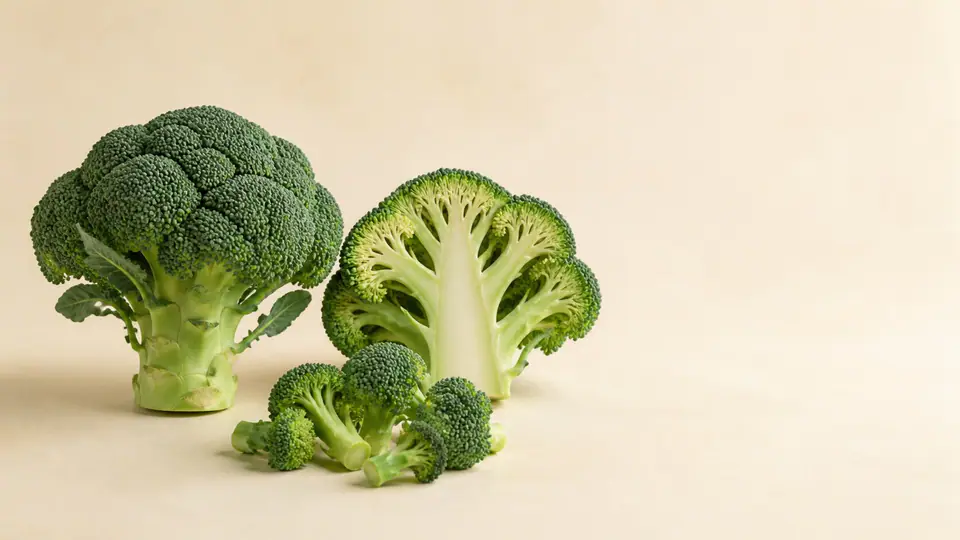
From split buds of wild cabbage to the expectations placed on broccoli
Does eating a lot of broccoli or broccoli sprouts help with cancer prevention or detoxification? This question is frequently repeated between a plate on the table and a single capsule. In short, while broccoli is a healthy vegetable, clinical results from human studies are not yet consistent enough to label it as 'cancer prevention' or 'detoxification.' So, what should we distinguish first: mature broccoli, raw sprouts, powder, or standardized extracts? Under the same name, different interventions actually exist.
Broccoli is not a separate wild species. It is a cultivated group selected for its edible flower heads within a single species called Brassica oleracea, and it is another form within the same species as kale, cabbage, and cauliflower. The Kew Gardens also describes them as different cultivated forms of the same species. In other words, broccoli is not so much a 'natural anti-cancer vegetable' as it is a variation of cabbage bred by humans for consumption. While this is interesting, it is also why we must be cautious of the narrative that it is 'inherently a plant that is good for cancer.'
A plate and a capsule are not the same raw material
There is a boundary that often becomes blurred when discussing broccoli. Mature florets, young sprouts, sprout powder, and glucoraphanin or sulforaphane extracts all share the name 'broccoli,' but they are not the same intervention because the plant part and the form and concentration of active ingredients differ. In cross-trials of sprout drinks, the bioavailability of pre-formed sulforaphane and the precursor glucoraphanin differed significantly, and it was difficult to predict actual exposure based on product labeling alone. In other words, the phrase 'contains broccoli sprouts' alone cannot determine how much sulforaphane one is exposed to.
The reasons for the expectations, and the reality behind them
Broccoli sprouts can be rich in glucoraphanin. The extent to which this component converts to sulforaphane varies depending on the conversion enzyme and formulation. Researchers have focused on changes in biomarkers that appear during this metabolic process. However, changes in metabolites or genetic and tissue markers are not direct evidence that broccoli prevents or treats cancer. There is a clear gap between observed possibilities and proven clinical effects.
In reviews of human interventions, there were signals in some blood glucose, lipid, and oxidative stress indicators, but the evidence for inflammation, Helicobacter, and cancer protection was less robust. A review of randomized trials of sulforaphane in cancer patients found that meta-analysis was impossible due to high heterogeneity across 8 studies, and clinical outcomes such as survival and PSA were inconsistent. This does not mean broccoli is harmful, but rather that the nickname 'anti-cancer vegetable' has outpaced the research evidence.
Do not conflate food research with extract trials
Research on broccoli as food cannot be interchanged with trials on standardized sprout drinks, extracts, or sulforaphane. A plate of vegetables provides fiber, vitamins, minerals, and an overall dietary pattern, whereas a capsule is a concentrated form of a specific component. Applying results from one to the other leads to conclusions where the dose, form of exposure, and study subjects are all different. Therefore, whenever you hear the sentence 'broccoli is good for XX,' you must first ask what form of broccoli was the subject of that study.
When taking with warfarin, and precautions for raw sprouts
The relationship between broccoli and medication is divided into two paths. For those taking warfarin, rather than avoiding broccoli entirely, it is important to maintain consistency with medical staff and avoid sudden, large changes in the intake of vegetables high in vitamin K. The key is not 'eating a lot or a little,' but 'not abruptly fluctuating the usual intake amount.'
Another precaution is food safety. Pregnant women, children, the elderly, and immunocompromised individuals should avoid raw sprouts or eat them thoroughly cooked due to the risk of bacterial contamination. It is also necessary to remember that concerns regarding the thyroid for general Brassica vegetable consumption are not viewed at the same level as those for raw sprouts or concentrated extracts. Cooked vegetables, raw sprouts, and concentrated products differ in the quality and quantity of risk.
Do not use non-standardized products as a substitute for treatment
Non-standardized sprout powders or extracts should not be used instead of cancer treatment. When choosing complex products, the full list of ingredients must be checked. If you choose based solely on the name 'broccoli,' you may purchase a product where the actual components and their amounts are unknown. Persistent weight loss, bloody stools, new lumps, or symptoms during treatment should be evaluated by a professional rather than managed with food. These signals are the body's warnings that cannot be hidden, no matter how healthy the raw material is.
How to View Differences from Similar Ingredients
Three axes are useful when comparing broccoli. First, broccoli, kale, cabbage, and cauliflower are different cultivated forms within the same species. Second, mature florets, sprouts, and extracts differ in the form and concentration of active ingredients. Third, exposure to glucoraphanin and sulforaphane is not the same as cancer prevention or treatment outcomes. If these three axes are not viewed simultaneously, a simple equation like 'broccoli = anti-cancer = detox' is created.
Realistic criteria to check today
When choosing broccoli, check three things first. First, whether it is mature broccoli food, raw sprouts, powder, or a standardized extract. Second, whether it is intended to replace cancer treatment or medication, and whether the actual research looked at biomarkers rather than clinical outcomes. Third, whether you are significantly changing vegetable intake while taking warfarin, or if a high-risk group for food poisoning is consuming raw sprouts. These questions should come before 'how much broccoli should I eat.'
Broccoli remains a highly nutritious vegetable. However, the way to use this material wisely is to first verify the exact cultivated group, plant part, formulation, sulforaphane bioavailability, the difference between biomarkers and disease outcomes, warfarin intake consistency, and raw sprout food safety, rather than relying on the nickname 'anti-cancer vegetable.'
References
- Kew Plants of the World Online: Brassica oleracea cultivar groups.
- Broccoli, glucoraphanin and sulforaphane in human trials: review.
- Sulforaphane in cancer RCTs: systematic review.
- Sulforaphane bioavailability from broccoli sprout beverages.
- FDA: Selecting and serving produce safely.
- Food and oral anticoagulant interactions: evidence review.
This text explains the origin of the raw materials, the scope of research, and precautions before consumption. As this cannot replace individual diagnosis or treatment, please consult a medical professional if you are taking medication or if symptoms persist. If sudden and severe symptoms such as difficulty breathing or decreased consciousness occur after consumption, seek help from 119 or the emergency room.

Medical Staff Review
Director Choi Yeon-seung
Chief Director of Baekrokdam Korean Medicine ClinicBroccoli Dictionary Entry, reviewed the safety of expressions and the scope of verification before administration.
Review scope: Ingredient origin, human studies, concomitant medications, safety of intake · Last reviewed 2026-08-17
- Graduated from Kyung Hee University College of Korean Medicine
- Providing Korean medicine treatment since 2010
- Consultations for Gongjindan, Gyeongokgo, Nokyong (Deer Antler) restorative medicine, and customized restorative herbal medicine