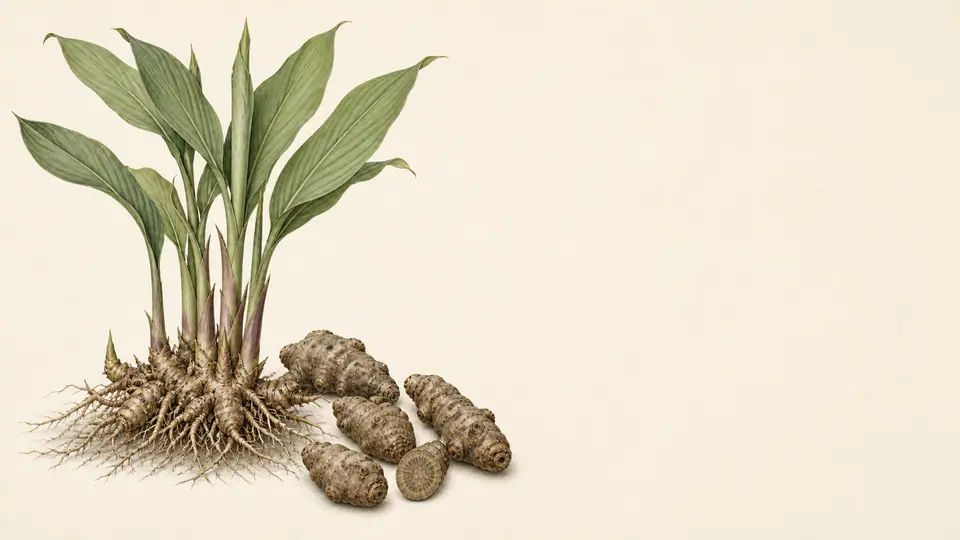
Bongchul: Named for Unblocking Flow
Can I take Bongchul for menstrual pain or abdominal masses? In short, while it has been used traditionally for such purposes, the risk of confusion between species/parts and signals of embryotoxicity in pregnant animals are precautions that must be checked before considering therapeutic effects in humans. The impression given by the name is a separate issue from the actual evidence.
Then, what should be checked first? The starting point is to verify the official source species, the part used, and the product form, rather than relying on a familiar name.
The Official Title Behind the Name Bongchul
Official domestic standards use the title 'Achul' rather than 'Bongchul'. Achul encompasses the rhizomes of three source species: Curcuma phaeocaulis, Curcuma kwangsiensis, and Curcuma wenyujin. Therefore, while the name Bongchul is more common in daily life, the title Achul is the primary term used when specifying the identity of the medicinal ingredient. Even if they originate from the same Hanja-based terminology, the standardized name and the folk name may not refer to the same scope.
Hard Rhizomes of Plants Related to Ginger
The Curcuma genus consists of plants closely related to ginger. The rhizomes of Bongchul are hard and clumped in form. The traditional understanding of unblocking flow and masses is embedded in its name and use, which created a context linking it to menstrual pain or abdominal masses. However, the impression given by the name is a separate issue from the actual evidence. Traditional uses may have arisen from observation and experience, but they cannot replace the disease diagnosis and treatment efficacy required by modern medicine.
The Gap Between Expectations and Evidence
Expectations for Bongchul generally fall into two categories: traditional use for menstrual pain and abdominal masses, and research on immunity and anti-cancer properties regarding the Curcuma genus. However, many of the activities found in Curcuma genus research remain in the preclinical stage, with only curcumin having a relatively large amount of clinical research. Therefore, research accumulated for Ulgeum (turmeric) or Ganghwang (turmeric) cannot be interpreted as applying to Bongchul. Research on C. zedoaria regarding cancer cells is merely a cytotoxicity screening test, not a treatment effect for human tumors or uterine fibroids. While expectations are widespread, the evidence is tied to specific species, specific extracts, and specific experimental conditions.
Different Ingredients Even Within the Same Genus
Ulgeum, Ganghwang, and Bongchul all belong to the Curcuma genus, but their species and medicinal parts differ. Ulgeum/Ganghwang capsules should not be viewed as the same ingredient as Bongchul essential oil. The differences are summarized in the table below.
| Comparison Target | Key Difference |
|---|---|
| Bongchul and the official title Achul | Bongchul is a folk name; Achul is the standardized title |
| Zedoary (Curcuma zedoaria) vs. Turmeric and Curcumin | Different species and parts, even within the same genus |
| Rhizomes vs. Tuberous roots | Different medicinal parts |
| Raw herbal medicine vs. Essential oil sesquiterpenes | Different raw materials and exposure levels |
Therefore, when looking at Bongchul (Zedoary) products, the phrase 'Curcuma genus' alone is not sufficient. You must first verify the specific species, the part of the plant used, and the processing method.
Different Exposure by Product Form
The National Institute of Food and Drug Safety Evaluation defines Zedoary as being in its raw form or steamed and dried. However, various forms are available on the market, including raw, steamed, vinegar-processed, and essential oil concentrates. These do not represent the same raw material or exposure. Raw herbal medicine and essential oil concentrates differ in component concentration and how they act within the body; therefore, their safety evaluations must be separate. A practical standard is to avoid products where the species, part, or extraction ratio is unclear.
When Taking with Other Supplements or Medications
What should you consider when using Bongchul with other medications or supplements? As a rule, concentrated products should not be added arbitrarily if you have menorrhagia (excessive menstrual bleeding), bleeding of unknown origin, are taking anticoagulants or antiplatelet agents, or have a scheduled surgery. In situations with a tendency toward bleeding, additional intake should be judged conservatively regardless of the raw material type. Additionally, caution is needed as it is easy to mistake Bongchul products for turmeric or curcumin products when using them alternately or concurrently.
Pregnancy and Bleeding: The Primary Boundaries
The first point raised in discussions regarding the safety of Bongchul is the signal of embryonic toxicity in pregnant animals. Studies on pregnant rats and embryos evaluating C. zedoaria essential oil sesquiterpenes reported embryonic toxicity and maternal changes. However, these are not tests that established the risk dose for humans using the three origin raw materials in Korea. Nevertheless, as a rule, it should not be self-administered during pregnancy, while preparing for pregnancy, or during breastfeeding due to preclinical signals of reproductive and developmental toxicity and a lack of human data.
Sudden severe pelvic pain, fainting, or bleeding with a possibility of pregnancy require immediate medical evaluation over the use of Bongchul.
Between Traditional Use and Modern Diagnosis
Traditional uses for menstrual pain or abdominal masses cannot replace the diagnosis of uterine fibroids, ovarian tumors, or pregnancy-related pain. An abdominal lump may not be a simple 'blockage' but a symptom requiring an ultrasound or appropriate medical examination. Identifying the cause must come before considering Bongchul.
How to Identify Differences from Similar Raw Materials
When choosing a Bongchul product, check three things. First, whether it is the rhizome of the three Zedoary origin species, or if it is turmeric, curcumin, or a tuberous root. Second, whether it is raw, steamed, vinegar-processed, or an essential oil concentrate. Third, whether you are pregnant, preparing for pregnancy, breastfeeding, experiencing menorrhagia or bleeding, or have a schedule for anticoagulants or surgery. These three questions are the minimum criteria for matching the identity of the raw material to your own situation before considering efficacy.
Realistic criteria to check today
Rather than the traditional expression of 'dissolving lumps,' first verify the species, part, processing method, possibility of pregnancy or bleeding, and a standard diagnosis. Bongchul is not as simple as its name might suggest. Various species and products are mixed under the broad umbrella of the Curcuma genus, and signals regarding pregnancy and bleeding have not yet been organized with human data. In other words, the final standard is clear: you can only determine which choice is possible after verifying the identity of the raw material, checking your own situation, and confirming the cause of the symptoms through medical evaluation.
References
- National Institute of Food and Drug Safety Evaluation Herbal Medicine Standards: Zedoary.
- Curcuma species immunomodulatory review.
- Curcuma zedoaria essential-oil reproductive toxicity in rats.
- Curcuma zedoaria rhizome cytotoxic constituents.
This text explains the origin of the raw materials, the scope of research, and precautions before consumption. As this cannot replace individual diagnosis or treatment, please consult a medical professional if you are taking medication or if symptoms persist. If sudden and severe symptoms such as difficulty breathing or decreased consciousness occur after consumption, seek help from 119 or the emergency room.

Medical Staff Review
Director Choi Yeon-seung
Chief Director of Baekrokdam Korean Medicine ClinicBongchul Dictionary Entry, reviewed the safety of expressions and the scope of verification before administration.
Review scope: Ingredient origin, human studies, concomitant medications, safety of intake · Last reviewed 2026-08-17
- Graduated from Kyung Hee University College of Korean Medicine
- Providing Korean medicine treatment since 2010
- Consultations for Gongjindan, Gyeongokgo, Nokyong (Deer Antler) restorative medicine, and customized restorative herbal medicine