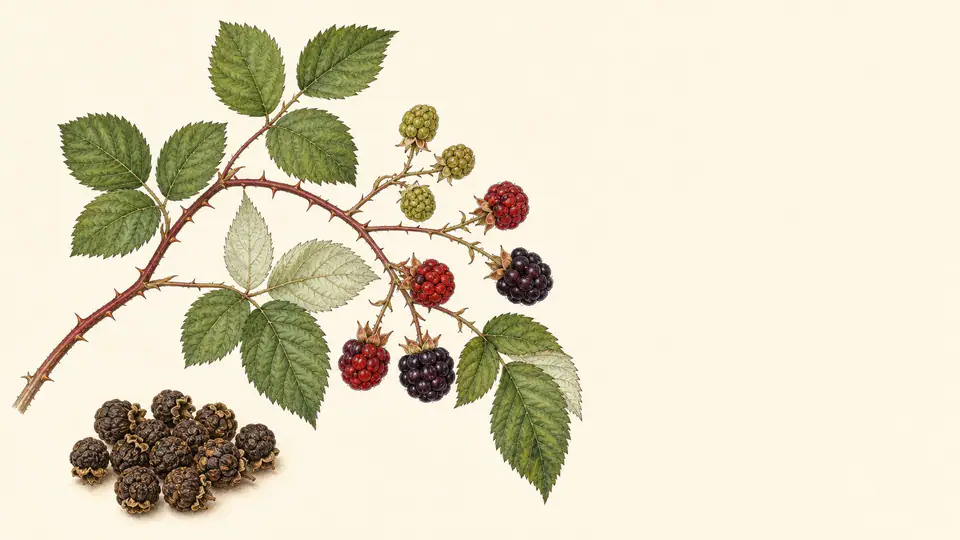
The Moment Summer Black Berries Become Medicinal Ingredients
Do Bokbunja (black raspberry) juice or Bokbunja wine have the same efficacy as medicinal Bokbunja? In short, even if the name is the same, it is difficult to view them as the same raw material.
Under the name 'Bokbunja,' ripe fresh fruit, juice, wine, and freeze-dried extracts of unripe fruit are all included, but they do not share the same components or research results. This article explores the timing hidden behind that name, the ripeness of the unripe fruit, the source plants, and the forms used in research.
Same Name, Different Timing
The herbal material bokbunja is not a fruit that ripens to black. The Korean Herbal Medicine Resource Research Center classifies bokbunja as long‑leaf bokbunja. Rubus chingii or Rubus idaeus Rubus coreanusunripe fruit. In other words, to be used as a medicinal unit, the fruit must be harvested before it is fully ripe. This difference in timing is the first fork in the road that leads to different substances despite having the same name.
Most products sold on the market as Bokbunja juice, Bokbunja wine, or Bokbunja powder use ripe fresh fruit or processed products as a starting point. These do not have the same component profile as unripe medicinal fruit, and research results cannot be applied to them simply because they share the same name.
Two Source Plant Species and the Possibility of Mixing
Bokbunja comes from the congeneric plants long‑leaf bokbunja and bokbunja strawberry. The Korean Herbal Medicine Resource Research Center lists both as origin plants of bokbunja, while also distinguishing the possibility of mixing with other congeneric species. This means that a raw material simply labeled “bokbunja” does not necessarily come from the same species, the same part, or the same stage of ripeness.
When a product label only says 'Bokbunja extract,' whether it is Rubus chingiior Rubus coreanuswhether it is unripe fruit or ripe fruit, and whether it is freeze-dried or another type of concentrate, requires separate verification. This distinction is not visible by the name alone.
What Human Studies Have Addressed
Some human studies on bokbunja (black raspberry) were conducted only under specific forms and conditions. In a randomized, double-blind trial involving 77 adults with borderline high cholesterol, freeze-dried unripe Rubus coreanus results showed signals that some lipid markers improved in the group that took 600 mg of extract for 12 weeks compared to the placebo group. However, this is a single small-scale trial.
Trials related to blood pressure evaluated a mixture of Hwangchil (Dendropanax morbifera) and unripe Bokbunja extract. Therefore, the effect cannot be isolated as that of Bokbunja alone. Trials for menopausal symptoms also evaluated a complex of Bokbunja and Astragalus extract, so they do not prove the efficacy of general Bokbunja food products or single raw materials.
In other words, positive signals regarding Bokbunja are limited to specific extracts, specific subjects, and specific periods; they are not evidence to replace hyperlipidemia medication, blood pressure medication, or menopausal treatments.
Fresh Fruit, Juice, Wine, and Extracts Are Not the Same Dosage Experience
It is risky to equate the experience of drinking bokbunja (black raspberry) juice or bokbunja wine with the experience of taking concentrated extracts. Fresh berries, juices, and wines are food forms that contain water, sugar, alcohol, and other raw materials. Freeze-dried extracts are concentrates derived from unripe fruit through specific processes.
When choosing a product, you should check the form of the bokbunja, whether it contains sugar or alcohol, and if it is blended with other ingredients. Even for products with the same name, comparisons become meaningless if the daily intake amount and the form differ.
How to Consider Concurrent Use and Individual Circumstances
Because human studies are small and short-term, safety regarding long-term high-dose use, pregnancy, breastfeeding, children, and concurrent use with various medications has not been established. Data on adverse reactions and drug interactions are also insufficient.
If you are taking medication for a chronic disease, it is necessary to inform your medical provider or pharmacist before starting bokbunja concentrated products. When choosing bokbunja, please check the following first: exactly what it is (fresh berry, juice, wine, powder, or unripe fruit extract), which goal you are targeting (blood lipids, blood pressure, or menopausal symptoms), whether you are currently receiving treatment, if the product contains sugar or alcohol, and if you have a history of allergies or gastrointestinal discomfort.
Different Things Under Similar Names
Four distinctions are helpful when understanding bokbunja.
| Category | Meaning |
|---|---|
| Unripe medicinal fruit vs. Ripe edible berry | The distinction between medicinal units and food depends on the ripeness. |
| Bokbunja strawberry vs. Rubus coreanus | The source plants are different, and there is a possibility of mixing. |
| Single extract vs. Complex with Hwangchil or Hwanggi | Research results for a complex cannot be applied to a single ingredient. |
| Food intake vs. Concentrates for therapeutic purposes | Expectations should differ if the purpose and form are different. |
This table shows how much is covered under the name 'bokbunja'. Missing even one distinction can distort the criteria for product selection.
The Gap Between Expectation and Evidence
The fact that there are positive research results for bokbunja is different from the fact that bokbunja juice or wine reproduces those effects in daily life. Most studies targeted specific freeze-dried extracts or complexes with other ingredients, and the number of participants and the duration were limited.
So, what can be expected? Bokbunja as a food can be enjoyed as food. However, it should not be expanded to a therapeutic effect for high cholesterol, blood pressure, or menopausal symptoms. It is an overinterpretation to view signals from small, short-term trials as evidence for treating a disease.
Criteria to Check Today
When selecting bokbunja, check the source plant, ripeness, formulation, and mixed ingredients before the name. You must distinguish whether it is a freeze-dried extract derived from unripe fruit, a processed ripe fresh berry, or a product mixed with other ingredients. Additionally, an attitude of not expanding small short-term trials to daily foods or disease treatment effects is necessary.
If hives occur, or if your lips or throat swell, or if you experience difficulty breathing, stop use immediately and seek emergency evaluation. Bokbunja is an ingredient where many different things are mixed under one name. Recognizing those boundaries is the first step in choosing this ingredient correctly.
References
- Korea Institute of Korean Medicine, Herbal Medicine Resource Research Center: Bokbunja.
- Unripe Rubus coreanus and cholesterol: randomized controlled trial.
- Hwangchil-unripe Bokbunja mixture and blood pressure: randomized trial.
- Rubus coreanus-Astragalus mixture for postmenopausal symptoms: randomized trial.
This text explains the origin of the raw materials, the scope of research, and precautions before consumption. As this cannot replace individual diagnosis or treatment, please consult a medical professional if you are taking medication or if symptoms persist. If sudden and severe symptoms such as difficulty breathing or decreased consciousness occur after consumption, seek help from 119 or the emergency room.

Medical Staff Review
Director Choi Yeon-seung
Chief Director of Baekrokdam Korean Medicine ClinicBokbunja Dictionary Entry, reviewed the safety of expressions and the scope of verification before administration.
Review scope: Ingredient origin, human studies, concomitant medications, safety of intake · Last reviewed 2026-08-17
- Graduated from Kyung Hee University College of Korean Medicine
- Providing Korean medicine treatment since 2010
- Consultations for Gongjindan, Gyeongokgo, Nokyong (Deer Antler) restorative medicine, and customized restorative herbal medicine