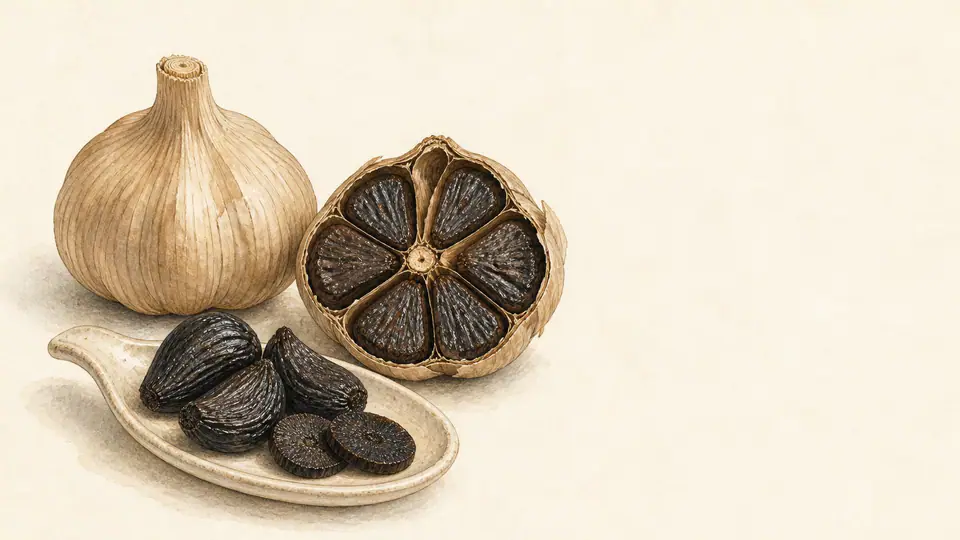
The sweetness of blackened garlic and the limits of a single pouch of juice
Is it better to drink black garlic juice every day for blood pressure or cholesterol than to eat raw garlic? In short, the evidence is narrower than the impression given by the black color and sweetness, and it varies by product. Black garlic is simply Allium sativuma food made by heat-treating and aging raw garlic for a long time under high temperature and humidity; it is not a separate fermentation bacteria or medicinal herb. Juices, concentrates, whole black garlic, and standardized extracts are different product categories, and their manufacturing methods differ even from Aged Garlic Extract (AGE), which has a similar name. Therefore, efficacy cannot be judged based on the single name 'black garlic'.
By following the process of how garlic becomes black and sweet, you can understand what expectations were attached, what research exists, and how far the black garlic juice in your home is from that research.
The Identity of Black Garlic: Heat-aging of garlic, not a separate plant
Black garlic is made by aging raw garlic for a long time, typically at high temperatures of 60–90 degrees and high humidity. During this process, the garlic turns black, the pungent spiciness decreases, and a sweet taste and soft texture develop. The black color and sweetness mainly come from the Maillard reaction and various component changes. Depending on the processing conditions, temperature, humidity, and duration, as well as the raw material variety, the content of sugars, moisture, and S-allyl-cysteine (SAC) varies. Even if they are called 'black garlic', they should be viewed as different products if the manufacturing methods differ.
There are two different types translated as 'aged garlic' in English: one is the heat-aged black garlic under high temperature and humidity mentioned above, and the other is Aged Garlic Extract (AGE), where raw garlic is soaked in water or ethanol and aged at room temperature for over 10 months. Both are 'aged', but their manufacturing methods and components differ. These two must be distinguished when reviewing research.
Why there are expectations for blood pressure and cholesterol
The reason for the interest in black garlic is that garlic itself is a food that has been consumed for a long time, and test-tube results have shown an increase in antioxidant-related components during the aging process. However, high antioxidant capacity in a test tube is a different story from its effect on human blood pressure, cholesterol, and cardiovascular events.
While there are studies on humans, the results are limited. In a trial observing 60 adults with mild hypercholesterolemia for 12 weeks, a specific black garlic preparation of 6g per day showed no significant difference from the placebo in LDL, total cholesterol, and triglycerides, with differences only in HDL and some other indicators. In a crossover trial of 67 people, a standardized black garlic extract containing 250mg of SAC per day showed signs of lowering diastolic blood pressure after 6 weeks, but this was a surrogate marker result for a specific product over a short period. Additionally, a small study of people receiving drug treatment for Stage 1 hypertension reported a small additional decrease in blood pressure with a standardized extract, but this does not mean it replaces medication or prevents cardiovascular events.
A clinical literature review on odorless aged/fermented garlic evaluated that even the best trials had fundamental flaws that prevented confirmation, and that differences in product composition and SAC dosage limit the interpretation of the evidence. In other words, it is difficult to apply research results to your own case if you do not know exactly what is in a particular black garlic product.
Differences between whole garlic, juice, concentrates, and standardized extracts
When buying black garlic, you will generally encounter 4 different forms. Whole black garlic is a food consumed as is. Black garlic juice is made by grinding the whole garlic into a liquid and often contains added sugars. Concentrates are more potent versions, so you must check the serving size and sugar content. SAC standardized extracts are supplement-form products where specific components are adjusted to a consistent amount.
Even if these 4 types start from the same raw material, their component concentrations and intake amounts differ. Most research uses specific extracts or standardized products, and there is a high possibility that juices or concentrates consumed at home are not identical to those. In particular, for juices and concentrates, you must check the added sugars and the serving size. It is risky to view the exposure of black garlic eaten as food and concentrated supplements as the same.
| Category | Characteristics | Points to Check |
|---|---|---|
| Whole black garlic | Food eaten as is | Intake amount, sugar content |
| Black garlic juice | Ground liquid | Added sugars, serving size |
| Black garlic concentrate | More concentrated liquid | Serving size, sugar content |
| SAC standardized extract | Supplement with specific adjusted components | SAC standardized amount, equivalence by product |
Precautions when taking with medications
Black garlic concentrate products share many characteristics with garlic supplements. Since garlic supplements may increase the risk of bleeding, it is necessary to inform your medical team if you are taking anticoagulants or aspirin, or if you have a scheduled surgery. If you are taking blood pressure medication, you should not attempt to reduce or stop your medication using black garlic. Research indicated that blood pressure decreased slightly more in people undergoing drug therapy, but this does not mean it can replace medication.
Additionally, oral intake of garlic may cause abdominal pain, gas, nausea, and allergic reactions. During pregnancy or breastfeeding, the safety of garlic supplements in amounts exceeding dietary intake is not sufficiently known. If you experience chest pain, difficulty breathing, paralysis, slurred speech, or symptoms of very high blood pressure, do not attempt to manage these with black garlic and seek immediate evaluation.
Individual circumstances and safety signals
When choosing black garlic, it is advisable to first assess your own situation. You should determine whether to consume whole black garlic, juice, concentrate, or SAC standardized extract; whether you can distinguish if a study focused on black garlic itself, an extract, or AGE; whether you are taking anticoagulants or aspirin or have a scheduled surgery; and whether you are intending to arbitrarily reduce your blood pressure medication.
These questions are not simple checklists, but tools to separate the various products and evidence mixed under the name of black garlic. Even if the name is the same, if the product in your hand differs from the subject of the research, the expected effects may also differ.
Raw Garlic vs. Black Garlic: What evidence can be compared?
It is difficult to compare raw garlic and black garlic simply by asking 'which is better.' Raw garlic is characterized by allicin-based components, while black garlic increases other components such as SAC due to heat aging. Research also does not consist of large-scale clinical trials directly pitting raw garlic against black garlic, but rather separate small-scale tests for each.
The 'reduced odor' often cited as a strength of black garlic is merely a food characteristic and does not guarantee clinical superiority. In fact, while the odor has decreased, some active components may have also changed. The choice of which form to use depends on individual gastrointestinal reactions, sugar intake, medication status, and personal expectations, rather than research evidence.
The gap between human-based evidence and disease prevention
Most figures appearing in black garlic research are surrogate markers such as blood pressure or lipids. A result showing that diastolic blood pressure decreased by a few mmHg is a signal that may be helpful for health, but it is not direct evidence that cardiovascular events such as myocardial infarction, stroke, or death were reduced. Furthermore, the scale of the studies is small, the duration is short, and they rely on specific products.
What then should you look for? First, you must distinguish whether the research is on black garlic itself, black garlic extract, or general AGE. Next, check if the product used in that research is the same as the one you are taking and whether the SAC is standardized. Finally, remember that small changes in blood pressure or cholesterol levels cannot be definitively concluded to lead to disease prevention.
Final Decision Criteria
When choosing black garlic, it is better to check a few things before looking at the blackened color or the expanded ingredient list. Look at the manufacturing method, the actual formulation, and the standardized amount. Evaluate whether the research was a human study specifically for black garlic, a small change in a surrogate marker, or distant from disease prevention. Check for medications you are taking, especially anticoagulants, aspirin, or blood pressure medication, whether there are gastrointestinal reactions, and the sugar content of the juice or concentrate.
Black garlic is a food made by transforming garlic, which has been consumed for a long time, into a different form. While this transformation provides clear advantages in taste and convenience, the evidence is still narrow for viewing it as a medication for lowering blood pressure and cholesterol or as a means of disease prevention. Before drinking one pouch every day, the starting point is to ask what kind of black garlic the product in your hand actually is.
References
- Black garlic production, bioactivity and application: critical review.
- Chemistry of aged garlic and preparation distinctions.
- Aged black garlic and lipid parameters: randomized trial.
- Standardized aged black garlic extract and cardiovascular risk: randomized crossover trial.
- Odourless aged or fermented garlic clinical evidence: systematic evaluation.
- NCCIH: Garlic usefulness and safety.
This text explains the origin of the raw materials, the scope of research, and precautions before consumption. As this cannot replace individual diagnosis or treatment, please consult a medical professional if you are taking medication or if symptoms persist. If sudden and severe symptoms such as difficulty breathing or decreased consciousness occur after consumption, seek help from 119 or the emergency room.

Medical Staff Review
Director Choi Yeon-seung
Chief Director of Baekrokdam Korean Medicine ClinicBlack Garlic Dictionary Entry, reviewed the safety of expressions and the scope of verification before administration.
Review scope: Ingredient origin, human studies, concomitant medications, safety of intake · Last reviewed 2026-08-17
- Graduated from Kyung Hee University College of Korean Medicine
- Providing Korean medicine treatment since 2010
- Consultations for Gongjindan, Gyeongokgo, Nokyong (Deer Antler) restorative medicine, and customized restorative herbal medicine