From a Blister-Inducing Defense Substance to a Named Treatment
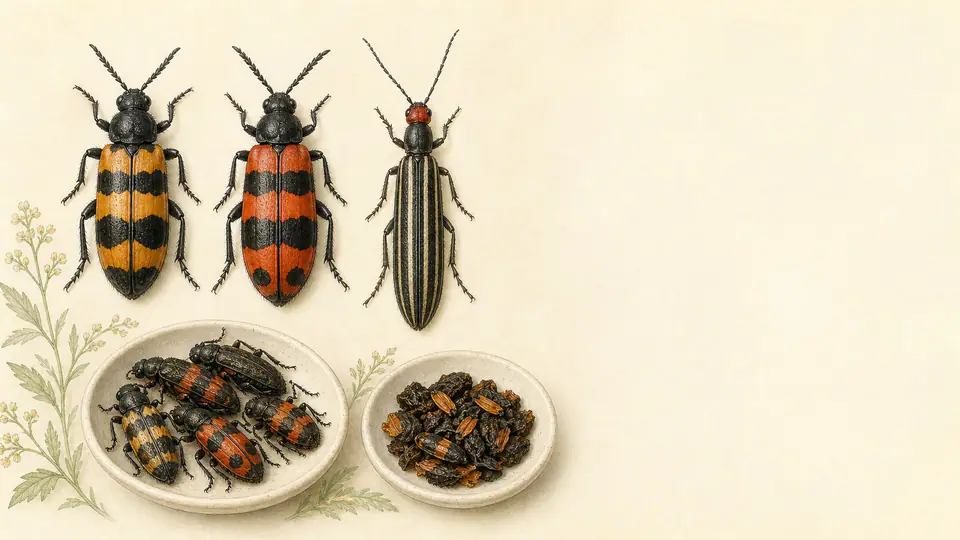
Is it okay to use Banmyo or cantharidin directly for warts or sexual function? In short, it is safer not to. Banmyo is Mylabris cichorii, Mylabris phalerata, Epicauta gorhami the dried body of a blister beetle, and the cantharidin within it is a potent substance that causes blisters even upon skin contact. Directly applying or ingesting raw materials is a completely different exposure scenario compared to the precise, localized doses of topicals used in medical institutions.
This gap must be clearly distinguished. Local application for wart treatment and oral ingestion as an aphrodisiac refer to the same substance, but their effects on the body are entirely different. What we must examine is how easily the fact that 'this substance is potent' is misunderstood as 'this blister is effective.'
Where the Questions Begin
Questions about Banmyo usually fall into two categories: a desire to remove skin warts, or a desire to enhance sexual function. In both cases, the name 'cantharidin' is the common link. However, similar questions do not lead to the same answer. The National Institute of Food and Drug Safety Evaluation defines Banmyo as the bodies of three blister beetle species and regulates the cantharidin content of the dried product to be 0.6% or higher. This definition alone shows that Banmyo is not just a simple insect, but a raw material containing a specific amount of a chemical substance.
Then why does the same raw material appear in completely different contexts, such as warts and sexual function? This is because cantharidin exhibits a local action that creates blisters. However, local action does not equate to a therapeutic effect, and when ingested orally, that action starts in the mouth and travels down through the gastrointestinal tract and urinary tract.
The Identity of Banmyo: Living Blister Beetles vs. Dried Bodies
When discussing Banmyo, the first distinction to make is between a 'living blister beetle' and a 'dried body.' Banmyo refers to the latter. Furthermore, other living beetles, medical-grade precise cantharidin topicals, norcantharidin, and powders or tinctures of unknown origin are not the same product. This distinction is not mere classification, but the starting point of safety. Because the names are similar, it is easy to assume they are the same and use them impulsively, but in reality, the exposure amount, exposure site, and level of formulation control are all different.
The term 'cantharidin' may make medical topicals, raw Banmyo, and illegal powders seem like one group. However, cantharidin preparations used in medical institutions have controlled concentrations, application sites, and application times. Conversely, applying Banmyo powder to the skin or ingesting it lacks such controls. Even with the same chemical substance, the risk level changes depending on the formulation.
Why Cantharidin Raised Expectations
Cantharidin is a substance produced by blister beetles for self-defense. The action of creating blisters upon skin contact is linked by some to a therapeutic image of 'peeling away lesions.' When applied to local lesions like warts, it may appear as if the epidermis is falling off. However, creating a blister does not mean it is a treatment. A blister is a sign of tissue damage, and if the depth and range are not controlled, it will damage healthy skin as well.
The use of cantharidin as an aphrodisiac stems from a similar misunderstanding. This substance, passed down under the name 'Spanish fly,' presents typical signals such as oral burning, difficulty swallowing, vomiting, hematemesis (vomiting blood), hematuria (blood in urine), and painful urination. These are not safe evidence of enhanced performance; rather, they are early signs of poisoning.
Differences Between Medical Topicals and Raw Materials/Powders
Norcantharidin also frequently appears as a point of comparison. Although it is a derivative created to reduce toxicity, urinary tract and organ toxicity, as well as vein irritation, remain. Therefore, the existence of norcantharidin does not justify the self-administration of Banmyo. In other words, reduced toxicity does not mean it is safe, and it is a separate issue from the uncertain concentration of raw Banmyo.
The difference between medical topicals and raw Banmyo is not simply a matter of purification. Medical preparations have set application sites, times, and concentrations, and there is a response system in place if side effects occur. In contrast, Banmyo powders or tinctures lack such controls and can damage healthy tissue beyond the intended lesion.
Which Organs Are Damaged Upon Ingestion
Cantharidin poisoning is reported to start with local blisters and progress to gastrointestinal mucosal shedding, visible hematuria, myocardial damage, and death. Treatment is primarily supportive care. In cases of children swallowing blister beetles, hematemesis, decreased consciousness, electrolyte imbalance, hematuria, and kidney damage were reported. In short, cantharidin can strip the mouth and stomach and damage the kidneys via the urinary tract. A decrease in urine output or the presence of blood in the urine is a signal that the kidneys have been affected.
Most of these poisoning cases resulted from unintentional exposure, folk remedies, or ingestion for aphrodisiac purposes. The fact that poisoning is rarely reported does not mean it is safe. The reporting of poisoning cases itself indicates that serious exposure has already occurred.
Concurrent Ingestion, Topical Application, and Exposure Scenarios
There is no specific evidence regarding the interactions when taking Banmyo with other medications or nutritional supplements. However, since poisoning affects multiple organs simultaneously, the risk may increase if the liver, kidneys, or heart are already under strain. Pregnant or breastfeeding women, children, and patients with kidney, liver, or heart disease must avoid exposure entirely. Even medical-grade topical cantharidin should not be used outside of a healthcare provider's instructions.
Banmyo is not simply something that 'should not be eaten,' but something where 'exposure itself must be minimized.' Skin contact alone can cause blisters, and it is even more dangerous if it touches the eyes, mouth, or genitals.
Individual circumstances and safety signals
Do not ingest Banmyo in its raw form, powder, or tincture, and do not apply it directly to warts, mucous membranes, or genitals. Access for children and pets must also be blocked. If it touches the skin, wash immediately with plenty of water; if extensive blisters form or it touches the eyes or mouth, seek emergency medical evaluation.
If oral burning, abdominal pain, vomiting, vomiting blood, bloody urine, painful urination, decreased urine output, or changes in consciousness occur after ingestion, immediately call 119 and use the emergency room. In such cases, do not induce vomiting. Inducing vomiting when the gastrointestinal mucosa is already damaged can cause additional injury.
The Gap Between Human Evidence and Expectations
Expectations for Banmyo mostly stem from the intuition that 'because it is a strong substance, it will have a strong effect.' However, strength and efficacy are different concepts. Medical-grade topical cantharidin is used for specific skin lesions because the concentration, application area, and post-application management are strictly defined. Raw Banmyo or powder lacks such controls.
Expectations regarding sexual function enhancement are even further from the evidence. Discussions related to 'Spanish fly' merely list signs of poisoning; they do not safely prove performance enhancement effects. Rather, ingesting a substance that causes oral burning and bloody urine is an act that harms the body.
Similar names, different ingredients
The confusion surrounding Banmyo stems from similarities in names. The body of the Banmyo blister beetle versus other beetles, medical-grade quantitative topical cantharidin versus self-application of raw material, cantharidin versus norcantharidin, and local wart treatment versus oral ingestion for aphrodisiac purposes are all different categories. Without making these distinctions clear, one risks dangerous exposure under the guise of 'natural raw materials.'
Criteria to Check Today
If you are considering Banmyo, first verify three things. First, distinguish whether it is an approved topical agent used by medical staff, or raw Banmyo, powder, or an illegal aphrodisiac. Second, determine if it touched the skin, eyes, mouth, or genitals, or was swallowed, and identify the duration and amount of exposure. Third, check for signs of poisoning such as oral burning, abdominal pain, vomiting blood, painful urination, bloody urine, or decreased urine output.
Do not mistake the action of creating blisters for a strong therapeutic effect; first verify the formulation, concentration, exposure site, and signs of poisoning. Banmyo is a raw material with a beautiful name, but the cantharidin within it is a substance that strips the body.
References
- National Institute of Food and Drug Safety Evaluation Herbal Medicine Standards: Banmyo.
- Cantharidin poisoning review.
- Cantharidin poisoning in children.
- Spanish fly cantharidin poisoning review.
- Norcantharidin delivery and residual toxicity review.
This text explains the origin of the raw materials, the scope of research, and precautions before consumption. As this cannot replace individual diagnosis or treatment, please consult a medical professional if you are taking medication or if symptoms persist. If sudden and severe symptoms such as difficulty breathing or decreased consciousness occur after consumption, seek help from 119 or the emergency room.

Medical Staff Review
Director Choi Yeon-seung
Chief Director of Baekrokdam Korean Medicine ClinicBanmyo Dictionary Entry, reviewed the safety of expressions and the scope of verification before administration.
Review scope: Ingredient origin, human studies, concomitant medications, safety of intake · Last reviewed 2026-08-17
- Graduated from Kyung Hee University College of Korean Medicine
- Providing Korean medicine treatment since 2010
- Consultations for Gongjindan, Gyeongokgo, Nokyong (Deer Antler) restorative medicine, and customized restorative herbal medicine