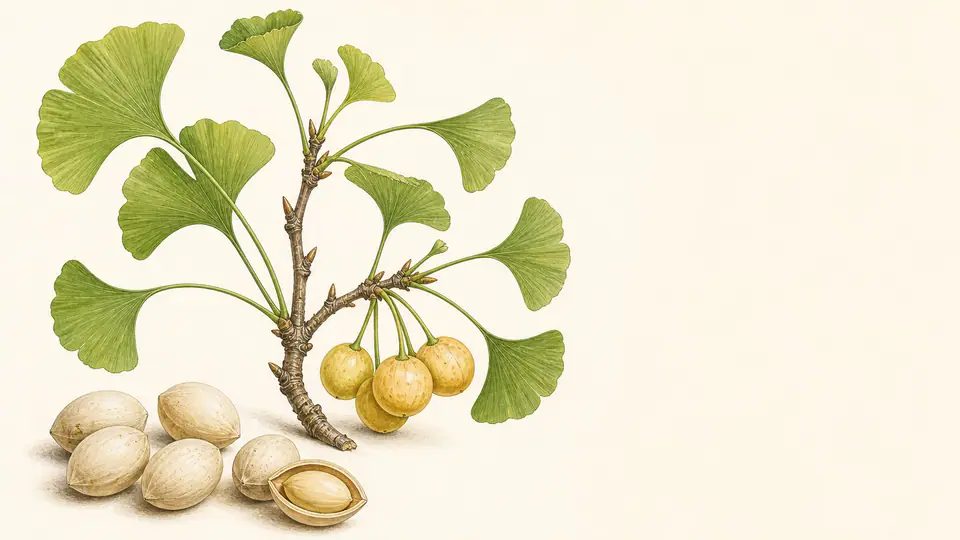
At the End of the Autumn Path, Opening the Hard Shell
How many cooked ginkgo nuts are safe, and why do seizures occur if too many are eaten? In short, there is no universal safety line of 'a few nuts' that is reliable for everyone. Cooking only changes the smell and texture; it does not eliminate the risk of overdose for children or in specific situations. Seizures occur because 4’-O-methylpyridoxine found in ginkgo seeds interferes with vitamin B6 metabolism, a mechanism detailed in toxicity reviews.
That gap must be clearly distinguished. We pass the strong scent of autumn streets to reach the green snack inside the hard shell, but the moment familiarity increases, it becomes the seed from which stories of neurological toxicity begin.
Two Different Worlds: Ginkgo Nuts are not Ginkgo Leaves
Ginkgo nuts (baek-gwa) are the inner seeds of the Ginkgo biloba fruit. The National Institute of Food and Drug Safety Evaluation defines ginkgo nuts as the inner seeds of the G. biloba fruit and separates the medicinal parts from the ginkgo leaves and the outer seed coat. However, in the market, ginkgo leaves, ginkgo leaf products, and ginkgo seeds are often lumped together.
Ginkgo leaves and their standardized extracts are parts with separate medicinal research. Ginkgo inner seeds are the edible part within the fruit, and clinical data cannot be used interchangeably between the two. The odorous outer fleshy seed coat is yet another distinct part. The fact that the parts and the exposure differ is the first boundary of this raw material.
Why a Familiar Snack Requires Caution
While ginkgo seeds have a long history of consumption, cases of infants and adults experiencing vomiting and generalized tonic-clonic seizures after excessive intake have been reported. In a case where a 21-month-old infant consumed approximately 50 g and another where a 2-year-old child consumed a large amount, decreased consciousness and seizures occurred. Children are particularly vulnerable because their lower body weight can lead to higher exposure even with the same number of nuts.
These cases demonstrate that giving 'several nuts as a snack' can lead to actual emergency situations. Toxicity reviews summarize that this is related to the mechanism where 4’-O-methylpyridoxine interferes with vitamin B6 metabolism. In other words, the toxicity of ginkgo seeds is not simple indigestion, but a structure that affects the nervous system.
Cooking Does Not Eliminate the Risk
Raw ginkgo nuts, cooked ginkgo nuts, peeled seeds, and the odorous outer seed coat are all different states. Cooking changes the taste and smell, but cooking alone does not create an unlimited safe amount applicable to everyone. Due to product form, individual differences, and actual intake amount, the conclusion that 'it is fine because it was cooked' does not hold.
Research has analyzed neurotoxic components in ginkgo-derived foods and medicines, showing that leaves and seeds or products should not be viewed as a single group, and that the raw material and content must be verified. In other words, when eating ginkgo seeds, one must consider both 'what it is' and 'how much'.
How Product Form Changes Exposure
Ginkgo inner seeds, ginkgo leaves, raw ginkgo nuts, cooked ginkgo nuts, and the odorous outer seed coat are all different exposure routes. Ginkgo leaves are researched in the form of standardized extracts, while ginkgo nuts are often consumed as raw food materials. Extracts are concentrated, making them difficult to compare with raw materials.
| Category | Key Question |
|---|---|
| Ginkgo Inner Seeds vs. Ginkgo Leaves | Are the medicinal parts and edible parts being confused? |
| Inner Seed vs. Outer Seed Coat | Is the odorous outer seed coat not the part for consumption? |
| Raw ginkgo nuts vs. cooked ginkgo nuts | Should we not avoid concluding that cooking alone changes the safe dosage? |
| Small amount vs. excessive amount | Is cumulative exposure based on age, weight, and intake amount considered? |
This table is a condensed version of the forms and selection criteria. Even if the label says 'Ginkgo', you must first verify whether it is the leaf or the seed, and whether it is raw or processed.
Situations requiring extra caution when combined
If you have a history of seizures or are taking anticonvulsants, it is recommended not to self-administer ginkgo seeds in medicinal doses. The same applies to those who are pregnant, breastfeeding, or have liver or kidney disease. It is important not to confuse them with ginkgo leaf products.
When taking multiple supplements together, you must check for overlapping ingredients. For example, if you consume ginkgo leaf supplements and ginkgo seeds on the same day, you might overlook the total exposure amount because the names are similar. In that case, what should you look for? You must first determine whether it is a ginkgo leaf supplement or ginkgo seeds, whether they are raw or cooked, and the actual number of seeds consumed.
Safety signals for children and the elderly
Do not give several ginkgo seeds to children as a snack, and store peeled seeds out of their reach. If repeated vomiting, tremors, generalized seizures, or decreased consciousness occur, do not put food or vitamins in the mouth and contact 119 immediately.
While it is explained that vitamin B6 may be used for treatment, this does not mean you should estimate the dose and self-administer at home. Emergency room evaluation takes priority. Do not assume a precise, universal safe number; instead, check the age, weight, intake amount, and product form, and avoid consuming large quantities at once.
The Gap Between Human Evidence and Expectations
Human studies on ginkgo seeds are reported primarily based on poisoning cases. This is not evidence to conclude that they have 'health-promoting effects'. It is also inappropriate to apply clinical data from ginkgo leaves to the Baekgwa (ginkgo seed) because they are different parts of the plant.
One reason for high expectations is that the name 'ginkgo' carries a medicinal image. However, you must remember that the plant part and exposure differ by raw material. Observed poisoning cases should be viewed as warning signals, not as proven safe dosages.
Similar names, different ingredients
Baekgwa (inner seed) and ginkgo leaves have similar names but are different raw materials. The inner seed is inside the odorous outer seed coat, and the outer seed coat is not the part for consumption. Raw and cooked ginkgo nuts only differ in their preparation state; this does not completely eliminate the risk of excessive intake.
A distinction must be made between daily small-amount intake and short-term excessive intake. Even a small amount can be a relatively high exposure for children, and consuming a large amount in a short time can lead to neurological symptoms.
Realistic criteria to check today
Prioritize checking the plant part, preparation, actual count, age, and neurological symptoms over the familiarity of ginkgo leaf efficacy or cooked snacks. For excessive exposure, prioritize emergency evaluation over folk remedies. Baekgwa is a material that starts from a simple definition as the inner seed of the ginkgo fruit and leads to confusion over names, differences in plant parts, risks of overdose, and emergency criteria.
References
- National Institute of Food and Drug Safety Evaluation Herbal Medicine Standards: Baekgwa.
- Ginkgo seed poisoning and 4'-O-methylpyridoxine review.
- Ginkgo seed poisoning with convulsions in a child.
- 4'-O-methylpyridoxine in infant ginkgo poisoning.
- Neurotoxic methylpyridoxine in ginkgo materials.
This text explains the origin of the raw materials, the scope of research, and precautions before consumption. As this cannot replace individual diagnosis or treatment, please consult a medical professional if you are taking medication or if symptoms persist. If sudden and severe symptoms such as difficulty breathing or decreased consciousness occur after consumption, seek help from 119 or the emergency room.

Medical Staff Review
Director Choi Yeon-seung
Chief Director of Baekrokdam Korean Medicine ClinicEncyclopedia Entry, reviewed the safety of expressions and the scope of verification before administration.
Review scope: Ingredient origin, human studies, concomitant medications, safety of intake · Last reviewed 2026-08-17
- Graduated from Kyung Hee University College of Korean Medicine
- Providing Korean medicine treatment since 2010
- Consultations for Gongjindan, Gyeongokgo, Nokyong (Deer Antler) restorative medicine, and customized restorative herbal medicine