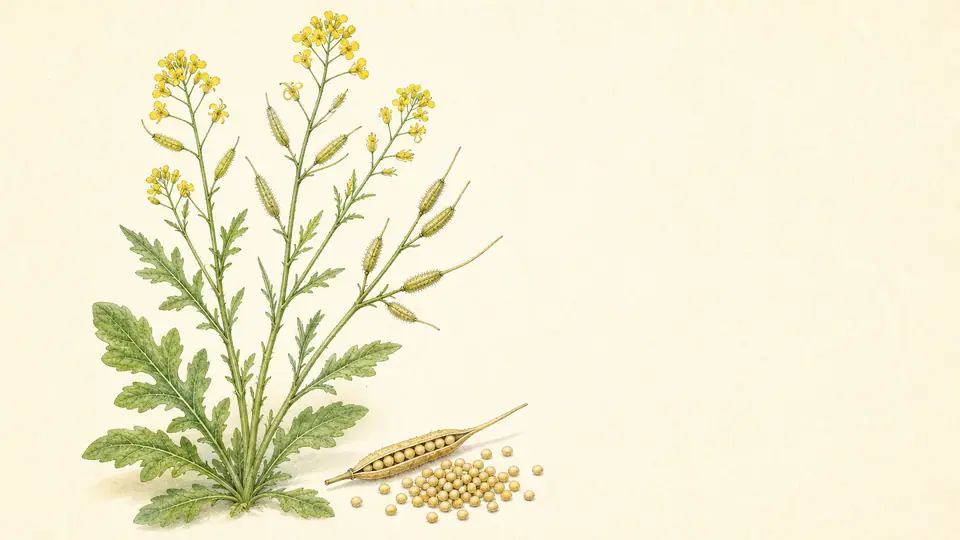
Baekgaeja, the seed whose name diverges in the palm of your hand
Can I take Baekgaeja powder for a cough or joint pain, or apply it to the skin? In short, this ingredient has too many 'faces' to decide based solely on the white color of the seed or the product name. Even for small seeds, if the scientific name differs, the specifications change; furthermore, applying it to the skin by mixing it with water creates a completely different level of exposure compared to small amounts used on the dining table.
Baekgaeja refers to the Sinapis albaripe seeds of white mustard. However, the medicinal herb commonly called Gaeja in Korea Brassica juncea specifies the seeds. Since it is difficult to distinguish the two by seed shape alone, mixing during distribution has been reported, and similar names do not mean they are the same medicinal herb. We will explore what kind of ingredient Baekgaeja is, why there are expectations for it, and the distance between those expectations and safety within the context of the raw material.
Where the questions begin: Cough, joint pain, and small seeds
Questions about Baekgaeja usually fall into two categories. One is oral intake to reduce respiratory or joint discomfort, and the other is external application by mixing it with water. Both methods utilize the pungent components of mustard seeds, but the amount of exposure and the risks differ from the start. The first thing to verify here is what is actually contained under the name 'Baekgaeja.' So, what should we look for?
Identity of the ingredient: What is Baekgaeja
Baekgaeja is Sinapis albathe seed of a plant. Data from the National Institute of Biological Resources explains the differences in naming and distribution between Chinese Baekgaeja S. albaand domestic Gaeja, B. junceaas well as the issue of imported product mixing. Since the Gaeja in domestic crude drug specifications B. juncea sets standards for seeds and allyl isothiocyanate, it is not automatically the same medicinal herb as the headword Baekgaeja. If you conclude it is Baekgaeja based only on the color of the seed or the product name, you may actually be dealing with a different species or a mixture.
Reasons for expectation: Pungent components and potential
When mustard seeds are crushed and mixed with water, irritating components of the isothiocyanate family are produced. This property is the background for its transition from a spice to a medicinal herb or a poultice. Recent reviews of white mustard cover a wide range of preclinical possibilities, but evaluate that clinical transition is limited and major allergen risks have not been resolved. In other words, while the potential action of the components is seen in research, it is not yet at a stage where consistent therapeutic effects in humans have been proven.
Formulation changes exposure: Culinary use, powder, essential oil, and external packs
There are four main ways to encounter Baekgaeja.
| Form | Characteristics |
|---|---|
| Table mustard sauce · small amount | Exposure level of everyday food |
| Powder · capsule | Oral administration possible in concentrated form |
| Essential oil | High-concentration exposure with undiluted liquid |
| External pack mixed with water | Delivers irritating components directly to the skin |
Small amounts used at the table, concentrated powders, and external packs differ greatly in exposure levels, even if they use the same raw material. Black mustard, brown mustard, white mustard, and domestic standard mustard also have different origins and component standards. Oral administration of undiluted essential oils and high-dose powders is not recommended, and there is insufficient safety data regarding medicinal doses for pregnant women, breastfeeding women, and children.
When taking or using together: Check these before combining
There is no evidence in the provided data that white mustard causes specific interactions with other medications or supplements. However, there are questions that must be checked before considering combined use. Whether it is white mustard S. alba seeds, or mustard B. juncea· black mustard, or a mixed mustard powder. Whether it is a small amount in food, or a tea, powder, capsule, essential oil, or external pack mixed with water. Also, whether there are allergies to mustard, rapeseed, or cruciferous foods, or if there is asthma, atopy, damaged skin, or if the person is pregnant, breastfeeding, or a child. The reason for asking these three things first is that the identity of the raw material, the formulation, and the individual's condition determine the risk.
Individual circumstances and safety signals
Mustard allergies can cause severe reactions even with small amounts of intake. If there is a history of reactions or if hives, throat swelling, or difficulty breathing occur, stop use; severe reactions require evaluation by 119. Caution is also needed for external use. Do not apply mustard powder mixed with water to the skin or seal it with plastic wrap; if burning, erythema, or blisters have already occurred, remove and wash immediately, and seek medical evaluation if the area is wide or severe. There have been cases of second-degree burns or toxic dermatitis after external use of mustard powder, so the method of leaving it on for a long time while enduring the stinging sensation is not safe.
If there is a persistent cough, shortness of breath, chest pain, blood-tinged sputum, or severe joint swelling and heat, evaluating the cause is a priority over using white mustard.
The Gap Between Human Evidence and Expectations
A review of mustard seed toxicity states that S. alba·B. juncea·B. nigraisothiocyanates, allergies, and other risk factors must be categorized by species, dose, and processing method. This serves as a reminder that research subjects are not always identical to actual products. While efficacy data centers on components, pre-clinical trials, and product-specific research, human cases of mustard allergies and external burns have been confirmed. Observed possibilities and proven therapeutic effects are at different stages.
Differences from similar raw materials
To understand white mustard, four pairs of comparisons are helpful: white mustard vs. current standard mustard, white mustard vs. brown and black mustard, table mustard vs. medicinal powder and essential oils, and oral intake vs. external packs mixed with water.
This distinction is not a simple classification, but means that different safety standards must be applied to each. Since it is difficult to differentiate by the appearance of the seeds alone, it is necessary to verify the scientific name, formulation, and whether other ingredients are mixed in.
Criteria to Check Today
If considering white mustard, check three things first. First, whether the product is Sinapis albaor if it is Brassica juncea·black mustard·mixtures. Second, the formulation and the extent of exposure. Third, whether there are mustard or cruciferous allergies, asthma, atopy, damaged skin, pregnancy, breastfeeding, or if the patient is a child. Furthermore, do not leave it on the skin for long periods or ingest high doses based on the belief that a stinging sensation is evidence of effectiveness. Checking the scientific name, potential mixtures, and formulation, rather than relying solely on the white color of the seeds or the product name, is the practical standard for identifying white mustard seed (Baekgaeja).
References
- National Institute of Biological Resources Report on Medicinal Plant Nomenclature and Distribution Identity.
- Ministry of Food and Drug Safety Crude Drug Standard: Mustard Seed.
- Mustard seeds: a toxicological perspective.
- White mustard narrative review.
- Mustard seed phytocontact dermatitis mimicking burn.
This text explains the origin of the raw materials, the scope of research, and precautions before consumption. As this cannot replace individual diagnosis or treatment, please consult a medical professional if you are taking medication or if symptoms persist. If sudden and severe symptoms such as difficulty breathing or decreased consciousness occur after consumption, seek help from 119 or the emergency room.

Medical Staff Review
Director Choi Yeon-seung
Chief Director of Baekrokdam Korean Medicine ClinicWhite Mustard Seed Dictionary Entry, reviewed the safety of expressions and the scope of verification before administration.
Review scope: Ingredient origin, human studies, concomitant medications, safety of intake · Last reviewed 2026-08-17
- Graduated from Kyung Hee University College of Korean Medicine
- Providing Korean medicine treatment since 2010
- Consultations for Gongjindan, Gyeongokgo, Nokyong (Deer Antler) restorative medicine, and customized restorative herbal medicine