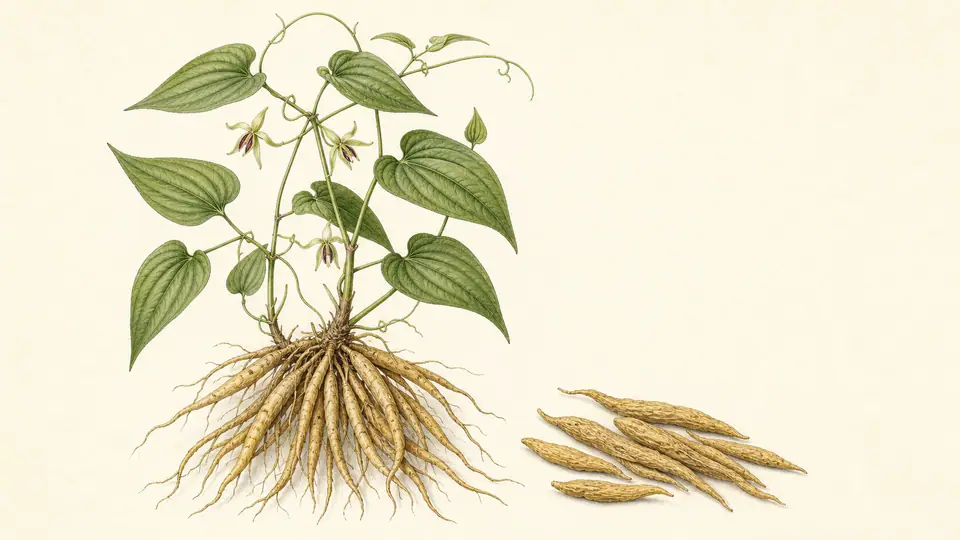
Tuberous roots gathered like a hundred roots, between coughs and insects
If a cough lasts a long time, would decocting and drinking Baekbugeun (Frasera root) be helpful like a cough medicine?
It is difficult to conclude that immediately. While Baekbugeun is remembered as a medicinal herb that addresses both coughs and insects, modern evidence remains limited to animal cough models and various alkaloids rather than human subjects.
That gap must be distinguished. Baekbugeun is not the raw root of a single species, but encompasses the processed tuberous roots of three origin species. Therefore, even with the same name, the contents differ slightly.
Context of the Question: What should be checked first when a cough lasts a long time?
If a cough persists for more than 3 weeks, or is accompanied by shortness of breath, chest pain, hemoptysis (coughing up blood), cyanosis, decreased consciousness, or high fever, a cause evaluation must take priority before choosing Baekbugeun. This is not pointing to a specific disease, but is a criterion to distinguish the point at which a cough may be more than a simple symptom.
Expectations for Baekbugeun have traditionally been tied to cough suppression and insecticidal effects. However, there are differences in product form and research subjects between the memory of stopping a cough and modern research. If these differences are not verified first, one may expect different results from the same name.
Identity of the Ingredient: A name shared by three species
Items based on the Standard Korean Medicine Terminology define Baekbugeun as the tuberous roots of Frasera speciosa Stemona sessilifolia, Frasera caroliniensis Stemona japonica, and Frasera trifoliolata Stemona tuberosaand specify processing by blanching or steaming and then drying.
All three species are called Baekbugeun, but different plants are mixed under the same name. Since there is one name but three different bodies, identifying the identity of the ingredient is the first step in administration.
Reasons for Expectations: Cough suppression and insecticidal activity
Stemona Alkaloid literature summarizes cough suppression and insecticidal activity in animal and insect experiments. Some chemotypes also show strong insect toxicity. This is the basis for Baekbugeun being remembered as a material that addresses both coughs and insects.
However, activity observed in animals and insects cannot be automatically linked to the same intensity or dosage in humans. Research only shows possibilities; it is not proof that can be directly applied as standard treatment for humans.
Differences in Product Form: Same Name, Different Exposure
Processed tubers of Frasera speciosa, raw roots or honey-processed products, total alkaloids, isolated components such as neotuberostemonin, and topical insecticidal uses do not represent the same exposure.
Decoctions and alkaloid fractions of three origin species were compared in a mouse study where coughs were induced by ammonia. The alkaloid composition and the strength of cough suppression in animals varied depending on the species, chemical type, origin, and whether they were raw or honey-processed. Due to these differences, standard human dosages or efficacy cannot be determined.
Pharmacokinetic studies of neotuberostemonin are also based on data from isolated components administered to rats and do not establish human absorption or safe dosages.
| Category | Research Subject/Form | Human Clinical Evidence |
|---|---|---|
| Processed tuber | Three Stemona species of tubers | Insufficient |
| Raw root/Honey-processed product | Separate exposure | Insufficient |
| Total alkaloids/Neotuberostemonin | Isolated components, rat data | None |
When Taking with Other Medications: What Should I Disclose?
When using Frasera speciosa alongside antitussives, expectorants, cold medicines, or sedatives, it is necessary to inform your medical provider or pharmacist of the exact product and dosage. Specifically, the consultation will be more detailed if you first confirm which of the three origin species it is, and whether it is a processed tuber, a honey-processed product, or an alkaloid concentrate.
You must also report how many weeks you have had a cough, and whether you have a fever, difficulty breathing, chest pain, coughing up blood, or weight loss. The duration of symptoms and warning signs are matters that must be determined before selecting the raw material.
Individual Circumstances and Safety Signals: Who Needs to Be Cautious?
There is insufficient human safety data regarding children, pregnancy, breastfeeding, and long-term concentrated use. Topical insecticidal products must not be ingested.
If severe nausea, vomiting, dizziness, muscle weakness, respiratory abnormalities, or allergic reactions occur, you must stop use and seek immediate evaluation. Adverse reactions are often overlooked while waiting for hopeful effects.
The Gap Between Human Evidence and Expectations
It is difficult to find high-quality clinical data on human coughs or long-term safety data for Baekbugeun used alone. Effects seen in animal cough models must be considered together with the number of studies, consistency, and limitations.
In other words, suppressing coughs in mice is not the same as treating chronic coughs in humans. The results of a single experiment are insufficient to serve as a basis for replacing human antitussives.
Differences from Similar Ingredients: What Should Be Compared?
When examining Baekbugeun, three Stemona Four comparison axes are useful: the processed tuberous roots of the origin species, raw versus honey-processed products, decoctions versus total alkaloids and neotuberostemonin, and mouse cough suppression versus human chronic cough treatment.
This comparison distinguishes the form of exposure and the associated targets rather than the ingredient itself. Even with the same name, one must consider which species, which processing method, which concentration, and which study the data came from.
Final Judgment Criteria: What to Verify Today
Prioritize verifying the species, processing method, alkaloid concentration, and the cause, duration, and warning signs of the cough over traditional memories of it stopping coughs. A realistic standard when choosing this ingredient is to avoid using animal cough models as a basis for replacing human antitussives.
Baekbugeun is an ingredient where several different rhizomes are grouped under one name. Only when we acknowledge the differences within that name can we ask the right questions.
References
- Baekbugeun entry based on the Standard Korean Medicine Terminology of the Society of Korean Medicine.
- Three pharmacopoeial Stemonae Radix species in a mouse cough model.
- Stemona alkaloid structures, distribution and biological activities review.
- Neotuberostemonine pharmacokinetics and distribution in rats.
This text explains the origin of the raw materials, the scope of research, and precautions before consumption. As this cannot replace individual diagnosis or treatment, please consult a medical professional if you are taking medication or if symptoms persist. If sudden and severe symptoms such as difficulty breathing or decreased consciousness occur after consumption, seek help from 119 or the emergency room.

Medical Staff Review
Director Choi Yeon-seung
Chief Director of Baekrokdam Korean Medicine ClinicBaekbugeun Dictionary Entry, reviewed the safety of expressions and the scope of verification before administration.
Review scope: Ingredient origin, human studies, concomitant medications, safety of intake · Last reviewed 2026-08-17
- Graduated from Kyung Hee University College of Korean Medicine
- Providing Korean medicine treatment since 2010
- Consultations for Gongjindan, Gyeongokgo, Nokyong (Deer Antler) restorative medicine, and customized restorative herbal medicine