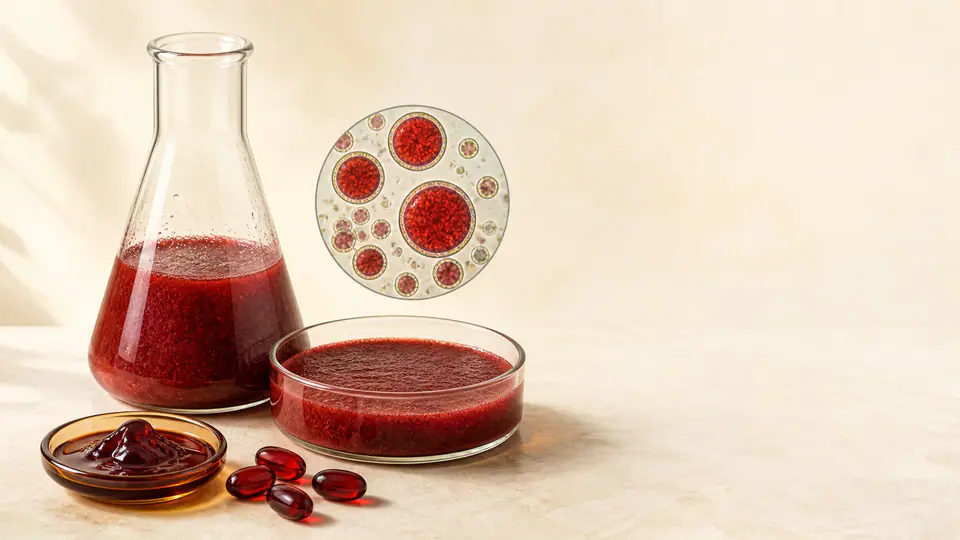
From the Food Chain to the Capsule: The Journey of Red Pigment
If I take astaxanthin, which is said to be good for eye fatigue, skin, and exercise recovery, is it the same as eating salmon, and is the antioxidant effect stronger?
In short, while the source of the color is the same, the form that reaches the body is not. The fact that it is a strong antioxidant in a test tube does not automatically translate to benefits for human eyes, skin, or athletic performance. Starting from the ecology of the red pigment, let's explore what questions a single capsule leaves behind.
Why Start the Question with Salmon?
Astaxanthin is a carotenoid produced by microalgae and yeast, which contributes to the red color of salmon, krill, and shrimp through the food chain. The starting point of the question is that the pigment accumulated by microalgae like Haematococcus to withstand intense light and nutritional stress flows directly into the flesh of fish and crustaceans. This is why many people place a piece of salmon and a supplement capsule on the same level. However, even if the color is the same, the conditions of the food and the extract containing that color are different.
Identity of the Raw Material: One Pigment, Many Forms
Microalgae-derived oleoresins used in supplements, synthetic astaxanthin, and the binding forms found in food all differ in composition, isomers, degree of esterification, and accompanying lipids. The term "naturally derived" can mask these differences. Furthermore, astaxanthin is not a nutrient that converts to Vitamin A, unlike beta-carotene. Even if the names sound similar, the pathways they take in the body are different. So, what should we look for? Beyond the identity of the raw material, we must first examine the reasons for the expectations.
Reasons for Expectation: Antioxidants and Membrane Alignment
The redox action and membrane alignment of astaxanthin are mechanisms currently being studied. Expressions of multiples compared to other antioxidants in a test tube, for example, "several times stronger antioxidant effect", are not rankings of efficacy in humans that reflect absorption, dosage, and actual disease outcomes. Test tube values do not mean that eye fatigue will be relieved, skin condition will change, or recovery after exercise will be aided. While the mechanism is interesting, expectations must go one step beyond that mechanism.
Between Food and Capsules: Same Color, Different Materials
Salmon or crustacean foods, microalgae oleoresins, and synthetic materials all contain the same red pigment but exist in different forms. One such difference is between natural ester forms and synthetic free forms, as well as differences in isomers. This is why it is difficult to say that a meal of salmon and a concentrated red oil capsule produce the same effect. In particular, many studies on skin, eye fatigue, and exercise recovery are small-scale trials using specific formulations for short periods, making it difficult to expect the same results from all commercially available capsules.
Current State of Evidence in Humans
Looking at cardiovascular and metabolic indicators, the results are inconsistent. An analysis of 280 people across 7 randomized trials in 2015 showed no significant changes in total cholesterol, LDL, HDL, triglycerides, or blood glucose. A 2020 meta-analysis of 14 trials also failed to confirm effects on fasting blood glucose, HbA1c, most lipids, weight, or blood pressure, showing only some signals in HDL and CRP subgroups. A meta-analysis of 7 studies including 321 people at risk for metabolic syndrome reported borderline changes in total cholesterol and systolic blood pressure, and some LDL signals, but concluded that more robust evidence is needed due to the small number and size of the studies. In other words, it cannot yet be viewed as a preventive agent for cardiovascular disease.
Distinction from Lutein and Beta-Carotene
It is easy to place astaxanthin on the same shelf as lutein or beta-carotene. However, beta-carotene can convert to Vitamin A, and lutein is a different carotenoid with the characteristic of selectively accumulating in the macular region of the eye. Astaxanthin does not follow those pathways. The gap between test tube antioxidant multiples and clinical results for the eyes, skin, and cardiovascular system is a point that must be kept in mind when simply comparing these materials.
When Taken Together: Small Changes in Indicators with Medication
If you are taking medication for blood pressure or blood glucose, it is necessary to inform your medical provider that you have started taking astaxanthin and any changes in your measured values. This is because some studies have shown the possibility of small changes in indicators. You must not reduce or stop your medication on your own. Supplements are not a replacement for prescription medication, but rather a reason to monitor your indicators more closely.
Individual circumstances and safety signals
While short-term studies show it is generally well-tolerated, if new symptoms such as gastrointestinal discomfort, headache, or changes in skin or stool color occur, stop use and check the product ingredients. Do not arbitrarily add concentrated products if you are pregnant, breastfeeding, a child, have liver or kidney disease, or have allergies to the raw materials or capsule excipients. Sudden vision loss, chest pain, fainting during exercise, or severe allergic symptoms should not be monitored with supplements; you must seek medical evaluation.
Criteria to Check Today
Rather than focusing on rankings as the 'strongest antioxidant,' first check the raw materials, isomers, esters and formulations, actual dosage, and complex ingredients. Additionally, consider the gap between the pigment's mechanism, small-scale short-term studies, and actual disease prevention. Regardless of the product you choose, first assess what you expect, whether it be for eye fatigue, skin, exercise recovery, or cholesterol; whether it is a food source like salmon, algal oleoresin, or a synthetic material; the actual content; and whether you have allergies to the ingredients, are pregnant or breastfeeding, or are taking blood pressure or blood sugar medications. While red pigments travel through the food chain, the extent to which the color in a capsule reaches its target is determined by the form of the raw material and the depth of the evidence.
References
- EFSA: Safety of astaxanthin as a novel food in food supplements.
- FDA GRAS response: Haematococcus pluvialis astaxanthin extract.
- Astaxanthin in people at risk of metabolic syndrome: systematic review.
- Astaxanthin and plasma lipids: systematic review and meta-analysis.
- Astaxanthin and cardiometabolic risk factors: systematic review.
This text explains the origin of the raw materials, the scope of research, and precautions before consumption. As this cannot replace individual diagnosis or treatment, please consult a medical professional if you are taking medication or if symptoms persist. If sudden and severe symptoms such as difficulty breathing or decreased consciousness occur after consumption, seek help from 119 or the emergency room.

Medical Staff Review
Director Choi Yeon-seung
Chief Director of Baekrokdam Korean Medicine ClinicAstaxanthin Glossary Entry, reviewed the safety of expressions and the scope of verification before administration.
Review scope: Ingredient origin, human studies, concomitant medications, safety of intake · Last reviewed 2026-08-17
- Graduated from Kyung Hee University College of Korean Medicine
- Providing Korean medicine treatment since 2010
- Consultations for Gongjindan, Gyeongokgo, Nokyong (Deer Antler) restorative medicine, and customized restorative herbal medicine